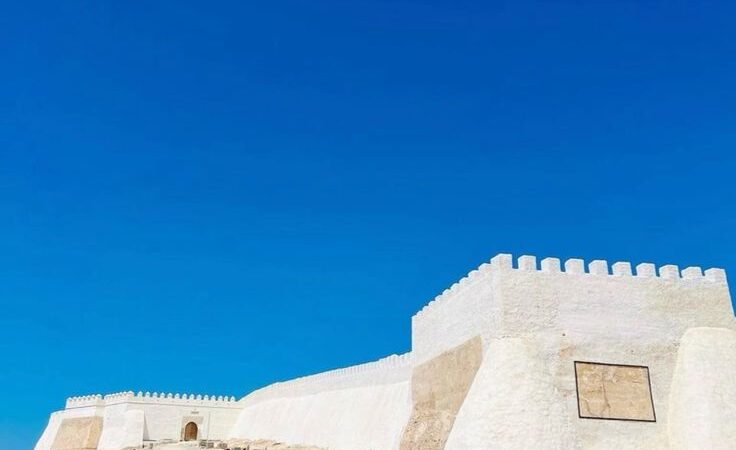
Agadir Oufella Kasbah rises 236 meters above the city, a silent sentinel of whitewashed stone watching over Agadir, the Atlantic and the vast Souss plain that stretches toward the Atlas Mountains. Of all the things to do in Agadir, a visit to the Kasbah Agadir Oufella is the one experience that puts everything else into perspective — literally and figuratively.
This ancient fortified citadel, rebuilt after the catastrophic 1960 earthquake that destroyed the original city, is more than a viewpoint. It is a place of memory, resilience and extraordinary beauty — especially at night, when the lights of Agadir shimmer below and the Atlantic stretches dark and infinite to the horizon.
A City Above the City
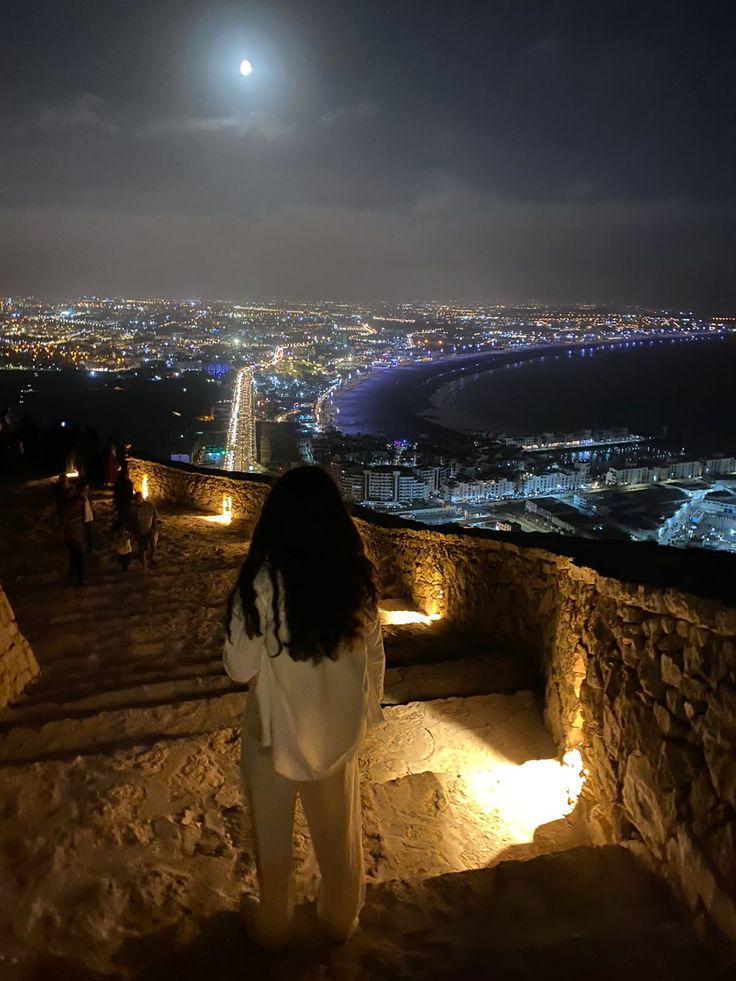
The Agadir Oufella Kasbah sits on a rocky hill north of the modern city, visible from almost everywhere in Agadir as a line of white crenellated walls against the blue sky or the dark night. The name Oufella means “upper” in the Amazigh language — and indeed, from up here, all of Agadir lies spread below like a map: the curved bay, the promenade, the port, the city streets extending into the Souss plain, and beyond it all, the endless Atlantic.
The view by day is spectacular. The view by night is something else entirely — one of the most beautiful urban panoramas in Morocco. The lights of the city trace the curve of the bay in a perfect arc. The promenade glitters along the waterfront. The fishing port pulses with activity. And above it all, the moon rises over the Atlantic while the ancient kasbah walls glow in warm golden light.
History: A City Built on a Hill
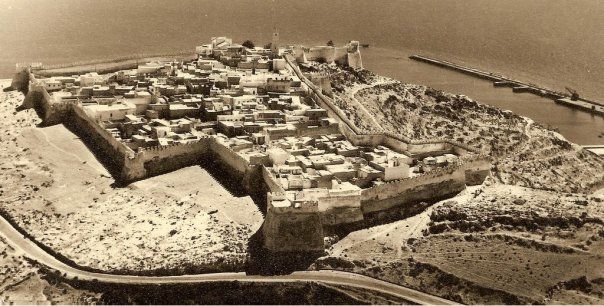
The history of Agadir Oufella goes back to the 16th century, when the original kasbah was built by the Saadian dynasty to control the prosperous trading port of Agadir below. At its peak, the hilltop citadel was home to a thriving community of several thousand people — merchants, artisans, scholars and soldiers — living within its thick walls above the Atlantic.
The kasbah changed hands several times over the centuries — Portuguese, Saadian, Alaouite — each ruling power leaving its mark on the fortifications. By the 20th century, Agadir Oufella had become a densely populated hilltop town, its narrow streets lined with houses, mosques and souks.
Then came the night of February 29, 1960. At 11:47 PM, a catastrophic earthquake measuring 5.7 on the Richter scale struck directly beneath Agadir. In less than 15 seconds, the old kasbah was almost entirely destroyed. Approximately 15,000 people — one third of the entire population of Agadir — lost their lives. It remains the deadliest natural disaster in Moroccan history.
The ruins of the old kasbah were left largely untouched as a memorial to the thousands who died there. The new Agadir was rebuilt on the plain below, becoming the modern resort city visitors see today. The hilltop remains a sacred site — a place of remembrance as much as a historical monument.
The Kasbah Today: Restoration and Memory
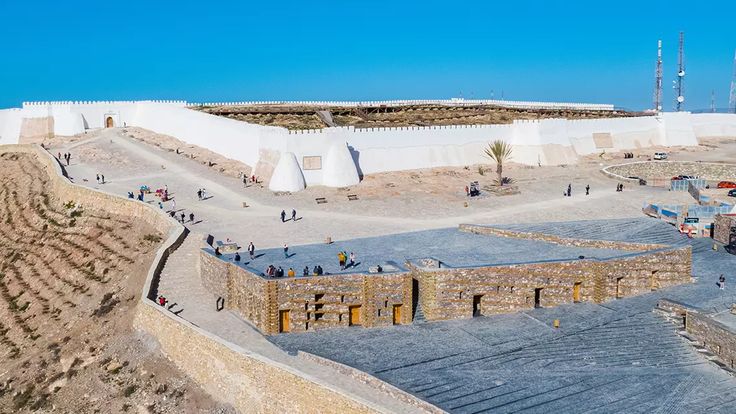
In recent years, the Agadir Oufella Kasbah has undergone significant restoration and development, transforming it from a simple ruin into one of the most visited attractions in southern Morocco. The outer walls have been beautifully restored in brilliant white lime wash, standing proud against the blue sky and visible from across the entire city below.
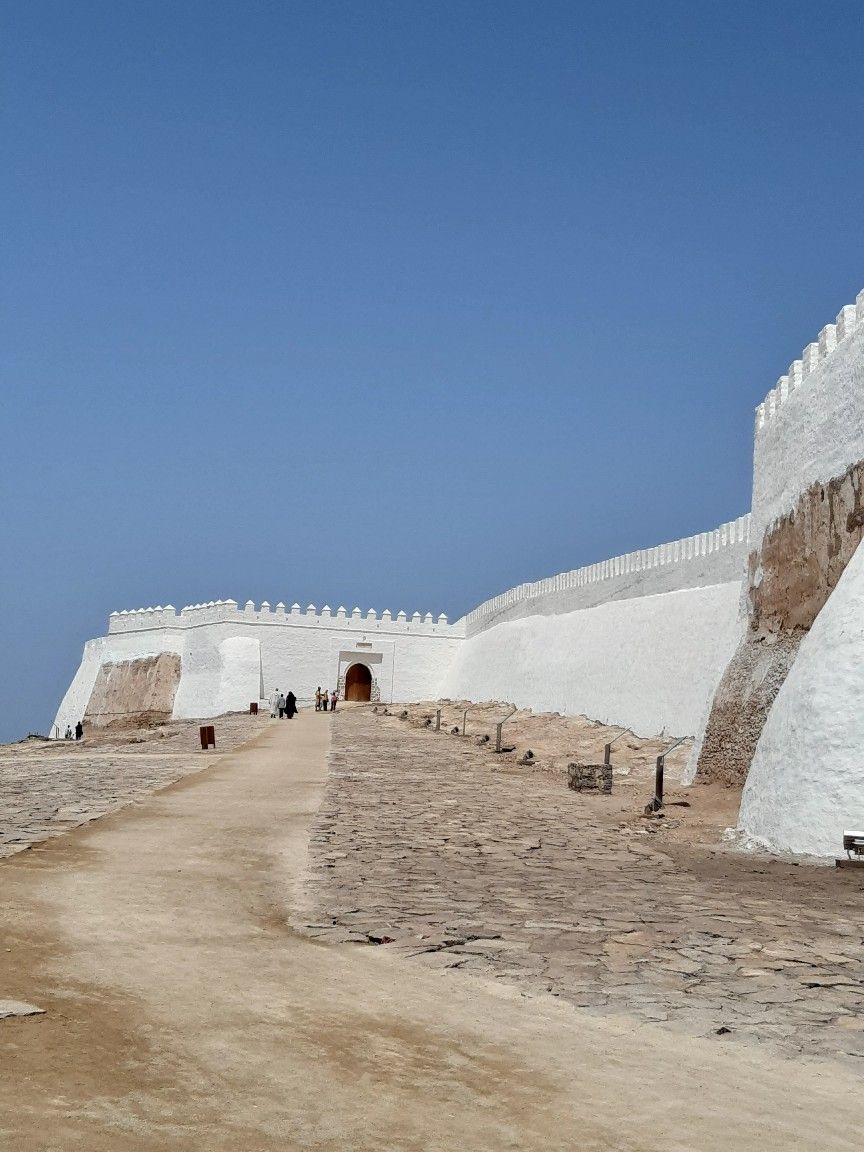
A broad cobblestone path leads up to the main gate — a traditional Moroccan arched doorway set into the massive white walls. The approach itself is impressive, with the ramparts rising above and the city visible through gaps in the hillside vegetation below.
Inside the walls, the ruins of the old city have been partially excavated and preserved. Stone foundations, doorways and walls emerge from the hillside — the ghostly remains of the community that lived here before 1960. Walking among these ruins, with the Atlantic visible in the distance and the silence broken only by the wind, is a quietly moving experience.
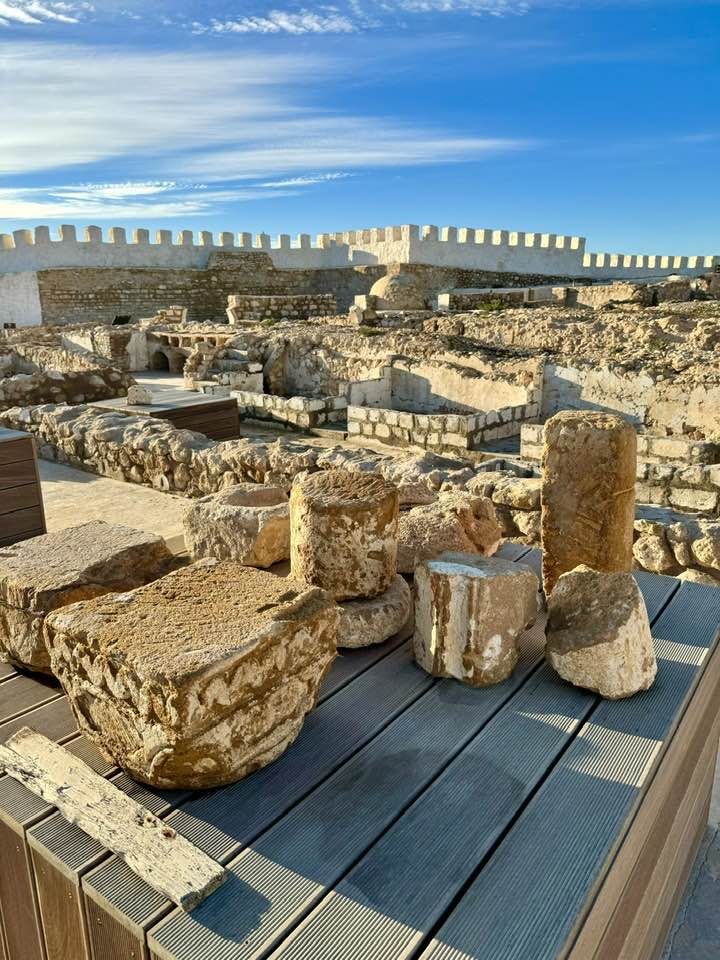
The restoration project has also added thoughtful visitor facilities — pathways through the ruins, informational panels in Arabic, French and English, seating areas with views over the city and a small visitor center at the entrance. The hilltop has been landscaped sensitively, with drought-resistant plants and stone terracing that complement the historic character of the site.
Camels, Sunsets and the Magic of Dusk
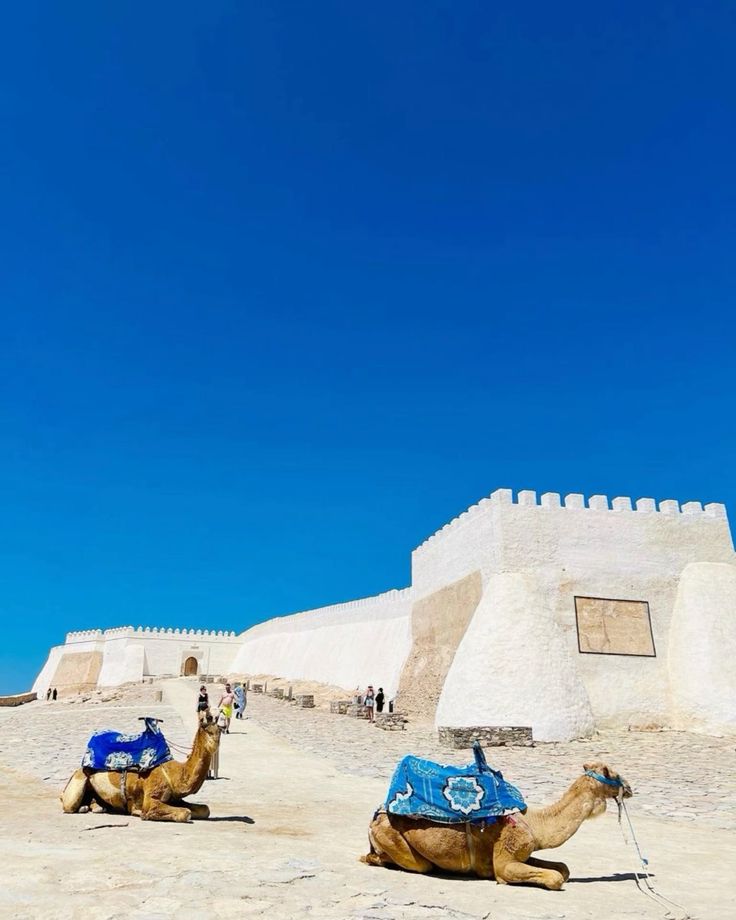
One of the unexpected delights of visiting Agadir Oufella is the presence of camels at the hilltop. Several camels are stationed near the entrance area, available for short rides and as photographic subjects against the backdrop of the white walls and deep blue sky. For visitors arriving in Morocco for the first time, this combination — ancient kasbah, white walls, camels and Atlantic panorama — is a powerful introduction to the country.
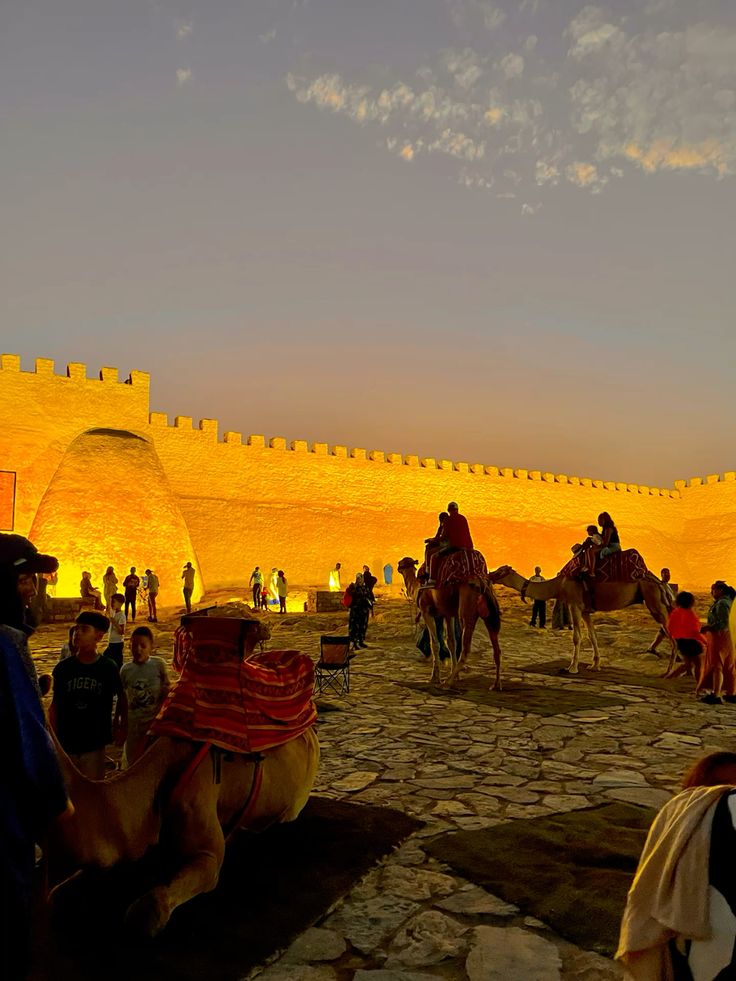
The sunset experience at Agadir Oufella is extraordinary. As the sun descends toward the Atlantic horizon, the kasbah walls turn from white to gold to a deep amber. The stones seem to glow from within. Camel riders silhouette against the sky. The city below begins to light up, one building at a time, as the sky fades from blue to orange to deep purple.
Many visitors consider the sunset from Agadir Oufella to be the single most beautiful moment of their entire trip to Morocco. It is worth planning your visit specifically around it — arrive at least one hour before sunset for the best experience.
The Inscription: Words That Survived
On the outer wall of the Kasbah, one of the most famous inscriptions in Morocco has been restored and preserved. Written in Arabic, it reads:
“If the hand of fate destroys your kingdom, it cannot destroy your glory.”
These words — attributed to various sources over the centuries — carry a particular weight here at Agadir Oufella. The kingdom was indeed destroyed, twice over: first by earthquakes, wars and the passage of time, and then definitively in 1960. But the glory — the memory, the culture, the city’s extraordinary resilience — endures. The inscription has become a symbol not just of the kasbah but of Agadir itself: a city that was destroyed and rebuilt, that suffered and endured, that looks out from its ancient hilltop over a modern, living, thriving city below.
Practical Information: Visiting Agadir Oufella Kasbah
Getting There
The Kasbah is located about 7 km north of Agadir city center, on the hilltop visible from across the bay. Options for getting there include taxi from the city center (around 50 to 80 MAD each way — agree on the fare before getting in), rental car with parking available at the base of the hill, or on foot via a 30 to 45 minute uphill walk from the lower neighborhoods (not recommended in summer heat).
Opening Hours
The Kasbah is open daily from approximately 8am to 10pm. Evening hours are the most popular — and for good reason. The site is illuminated beautifully after dark and the nighttime panorama is extraordinary.
Entry
Entry to the Kasbah is free. Small fees may apply for camel rides and for access to certain viewing areas within the site.
Best Time to Visit
- Sunset (1 hour before until 1 hour after) — the most spectacular time, with golden light on the walls and the city lights beginning to appear below. Arrive early to get the best spots.
- Night — the panoramic view of the illuminated city from the kasbah walls is one of the most dramatic sights in Agadir. The kasbah itself is beautifully lit.
- Morning — cooler temperatures, fewer crowds, excellent light for photography of the white walls against the blue sky.
- Avoid midday in summer — the hilltop is fully exposed and temperatures can exceed 40 degrees C with no shade.
What to Bring
Water (there are no shops inside the walls), sun protection, comfortable shoes for the cobblestone paths, a camera or phone for the views, and a light layer for the evening when the Atlantic breeze can make it cool after sunset.
Agadir Oufella: A Place That Stays With You
There are viewpoints, and then there are places that change how you see a city. Agadir Oufella Kasbah is the second kind. Standing on its ramparts, looking out over the bay that the Phoenicians sailed, that the Portuguese fortified, that the Saadians ruled and that the 1960 earthquake changed forever — you feel connected to something much larger than a holiday destination.
Agadir is a young city in many ways — rebuilt from scratch in the 1960s and 1970s, modern, clean and resort-oriented. But from the Kasbah Oufella, you see the deeper story: the ancient hilltop, the fishermen’s port below, the argan forests stretching toward the mountains, the Atlantic that has watched over all of it for millennia. It is a perspective worth seeking — and one you will not forget. For more information about visiting Agadir, visit Visit Morocco or explore our other travel guides on Explora Agadir.