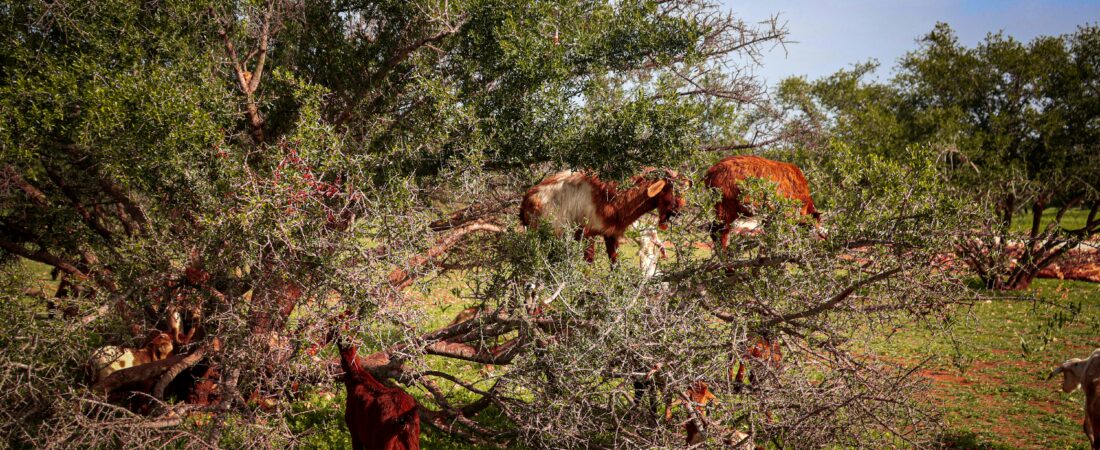
Deep in the sun-scorched plains of southern Morocco, between Agadir and Essaouira, grows one of the most extraordinary trees on earth. The argan tree — Argania spinosa — has survived here for 80 million years, long before the Sahara existed, long before humans walked these lands. From its small, olive-like fruit comes argan oil Morocco, one of the rarest and most precious natural oils in the world.
Known as “liquid gold,” argan oil from the Souss-Massa region near Agadir is at the heart of Amazigh culture, economy and cuisine. This is its story — from tree to bottle.
The Argan Tree: A Living Fossil
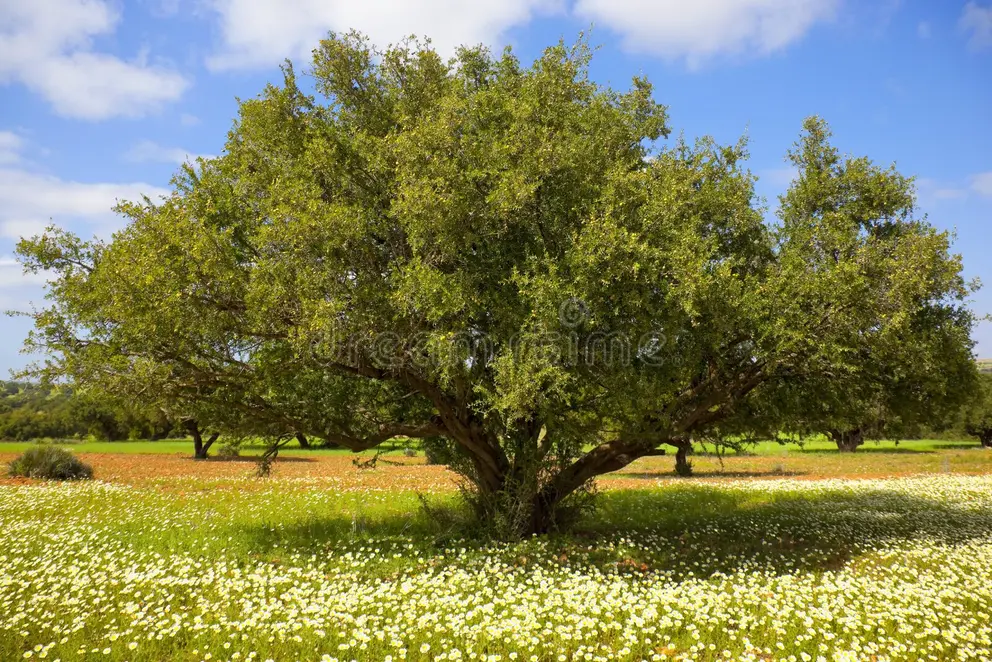
The argan tree is unlike any other. Gnarled, thorny and seemingly inhospitable, it thrives where nothing else can — in the semi-arid, rocky soils of the Souss Valley and the Anti-Atlas foothills between Agadir and Essaouira. It can live for up to 200 years, survive years of drought, and its deep root system prevents soil erosion across an entire ecosystem.
UNESCO recognized the argan forest as a Biosphere Reserve in 1998, protecting some 800,000 hectares of this unique ecosystem. The argan tree is not just an agricultural resource — it is a keystone species that holds an entire landscape together.
The tree produces a small, fleshy fruit that looks like a large olive. Inside the fruit is a hard-shelled nut, and inside that nut are one to three kernels — the source of argan oil. Extracting those kernels is a labor of extraordinary patience and skill.
The Goats of the Argan Forest
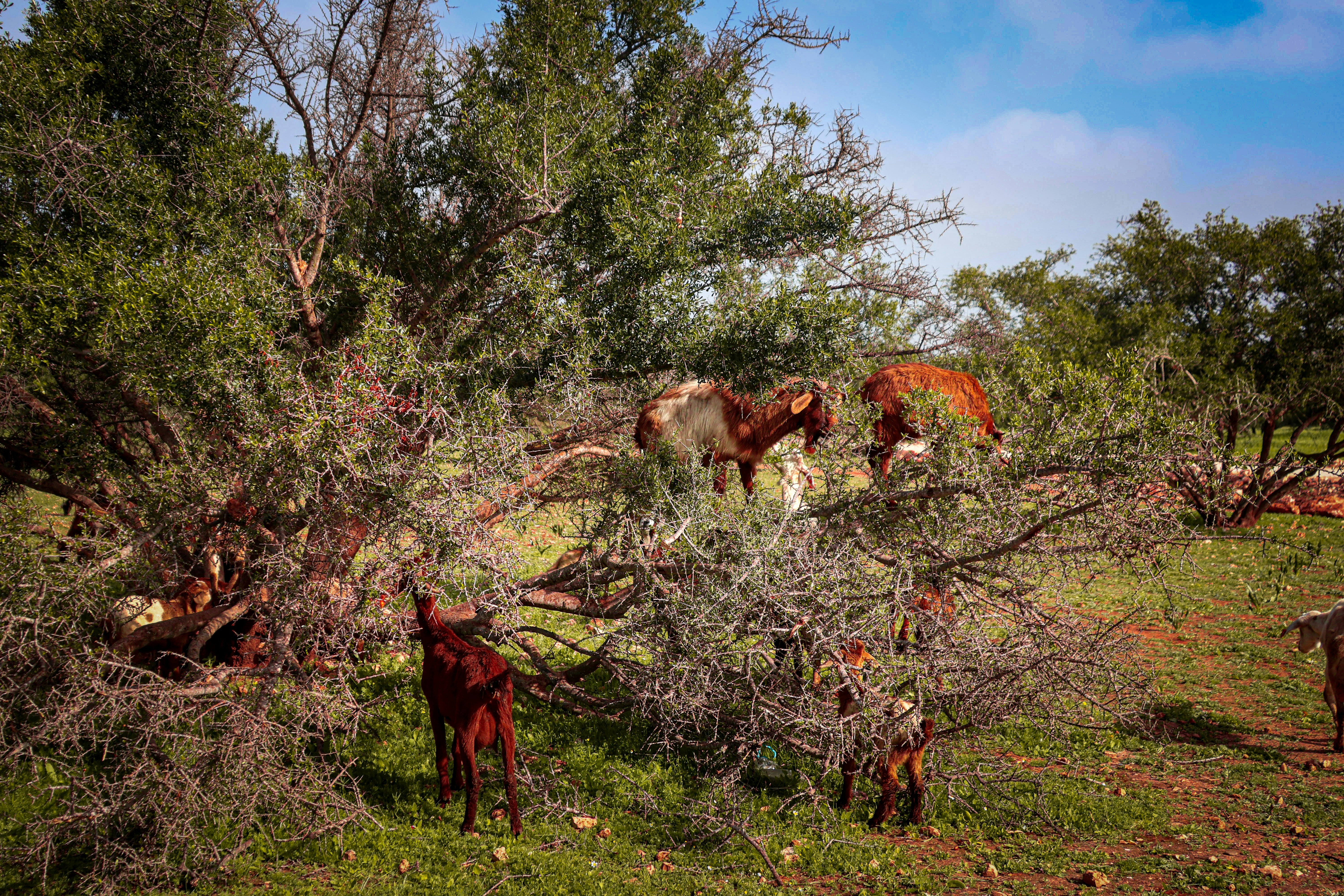
One of the most extraordinary sights in southern Morocco — and one that surprises every visitor — is that of goats perched high in the branches of argan trees. These nimble animals, bred for centuries in the Souss region, have learned to climb the thorny trees to reach the sweet, ripe argan fruit at the top.
The goats eat the entire fruit but cannot digest the hard inner nut. They pass the nuts whole, and for centuries, local communities collected these passed nuts and cracked them open to extract the kernels — a process that sounds unusual but was an efficient natural harvest method.
Today, with argan oil production industrialized and standards raised, most producers collect the fruit directly from the trees before the goats can eat them. But the sight of the climbing goats remains one of the most photographed and memorable experiences along the road between Agadir and Essaouira — a living symbol of the unique relationship between people, animals and landscape in the Souss region.
The Ancient Art of Extraction
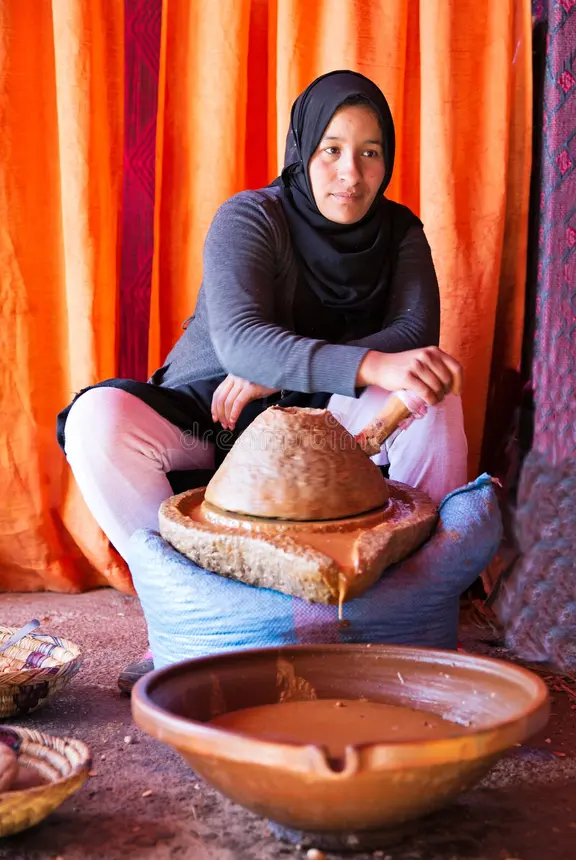
The traditional production of argan oil is an entirely manual process that has barely changed in thousands of years. It is almost exclusively the work of Amazigh women — a skill passed from mother to daughter across countless generations in the villages of the Souss-Massa region.
The process begins with cracking the incredibly hard argan nut. Each nut must be cracked individually between two stones, a task requiring both strength and precision — too hard and you crush the kernel, too soft and the nut does not open. Cracking enough nuts to produce one liter of oil takes a skilled woman approximately 15 to 20 hours of work.
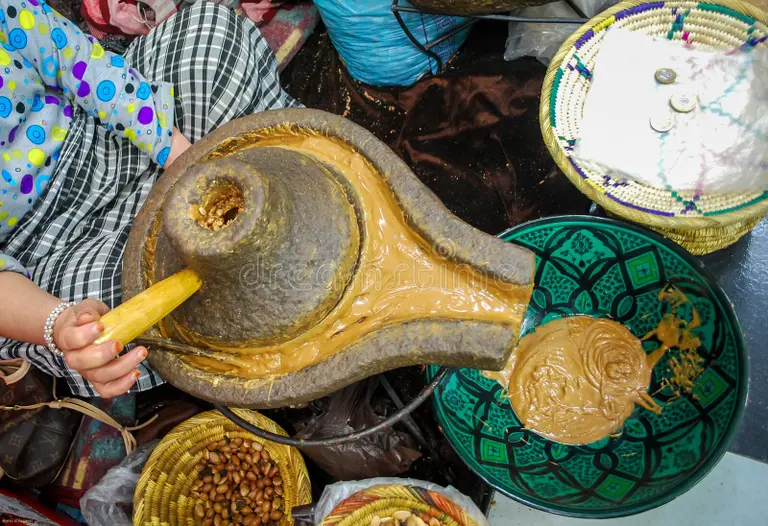
Once the kernels are extracted, they are gently roasted (for culinary argan oil) or left raw (for cosmetic argan oil). The roasted kernels are then ground on a traditional stone mill — a heavy circular stone rotated by hand — into a thick, fragrant brown paste. Water is added gradually as the paste is kneaded by hand, and the oil slowly separates and rises to the surface.
The result of all this labor — one liter of pure, cold-pressed argan oil — is worth every minute of work. The flavor is rich, nutty and complex, unlike anything else in the world of culinary oils. The aroma fills the room the moment the bottle is opened.
Two Oils, Two Worlds
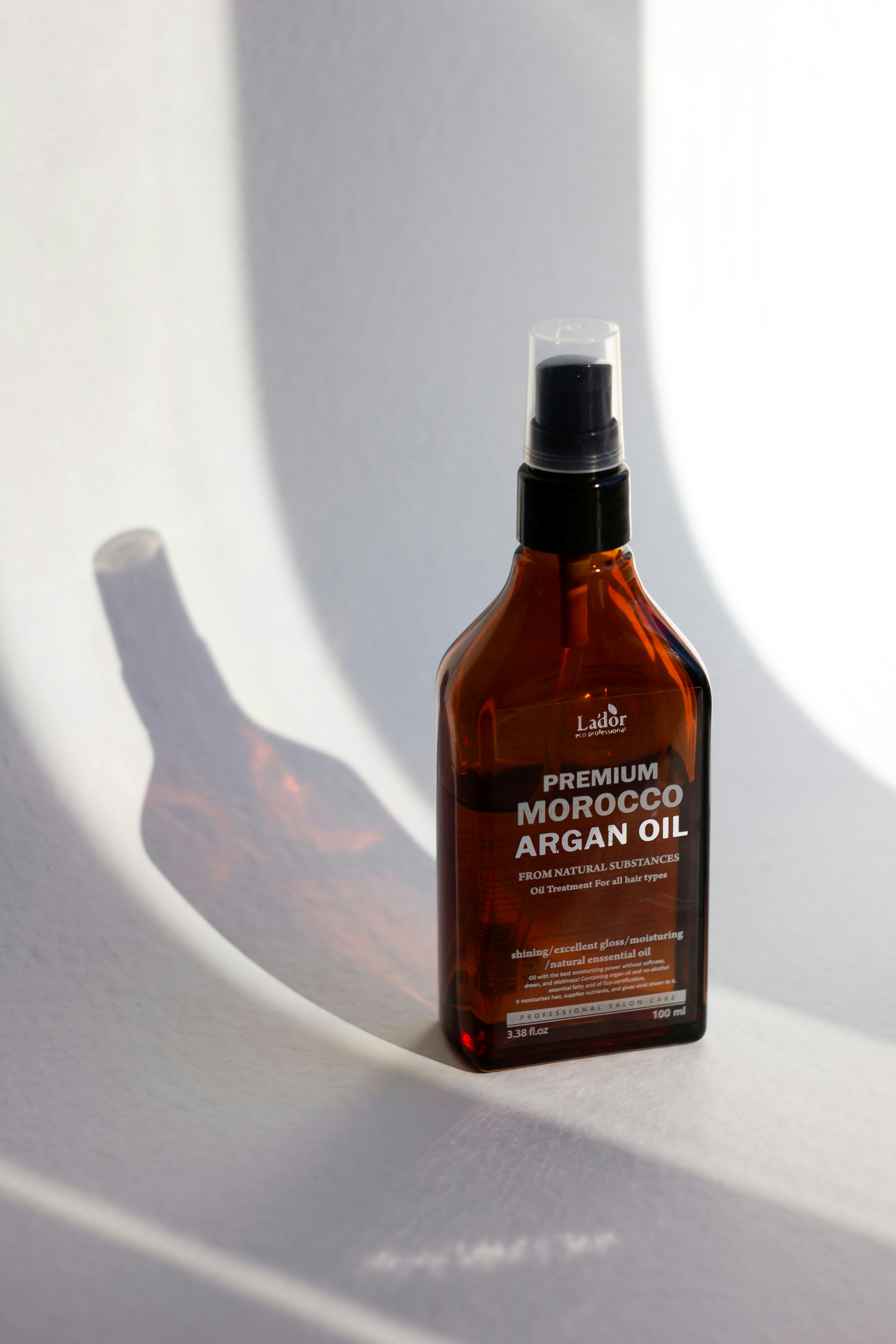
There are two distinct types of argan oil, and understanding the difference is essential before you buy.
Culinary argan oil is produced from roasted kernels. The roasting process gives it a deep amber color, a rich nutty flavor and a distinctive warm aroma. It is used as a finishing oil — drizzled over couscous, salads, hummus and amlou (a traditional Amazigh paste made with argan oil, almonds and honey). It is never used for frying as high heat destroys its delicate compounds. A few drops over a piece of fresh bread with a cup of mint tea is one of the finest simple pleasures southern Morocco has to offer.
Cosmetic argan oil is produced from raw, unroasted kernels. It has a lighter color, a more neutral scent and a higher concentration of vitamin E, antioxidants and essential fatty acids. It is used as a moisturizer, hair treatment and anti-aging skin oil. A few drops massaged into damp skin or hair after washing is all that is needed — it absorbs quickly without leaving a greasy residue.
The Women’s Cooperatives: A Revolution in the Souss
One of the most important stories in the argan oil industry is the rise of women’s cooperatives across the Souss-Massa region. Since the 1990s, hundreds of small cooperatives have been established in villages around Agadir, Taroudant and Tiznit, bringing together groups of Amazigh women to produce and sell argan oil collectively.
Before the cooperatives, argan oil production was domestic work — done at home, unpaid, for family use or sold informally for very little. The cooperatives changed everything. Women now receive fair wages, work in clean and safe conditions, own shares in their cooperative and receive training in quality control, hygiene and business management.
The impact on rural communities has been profound. Women who previously had no independent income now support their families, educate their children and own property. The cooperatives have also established quality standards that have helped Moroccan argan oil gain international recognition and premium prices in markets across Europe, North America and Asia.
When you buy argan oil from a certified women’s cooperative in the Souss region, you are not just purchasing an exceptional natural product — you are participating in one of Morocco’s most successful stories of women’s empowerment and sustainable development.
How to Use Argan Oil: A Guide
In the Kitchen
- Amlou — Mix culinary argan oil with ground roasted almonds and honey for the traditional Amazigh breakfast spread
- Salad dressing — A drizzle of argan oil over a tomato and cucumber salad with a squeeze of lemon
- Couscous finishing oil — Add a spoonful to your couscous just before serving for depth and richness
- Bread dipping oil — Serve with fresh khobz bread and a pinch of sea salt
For Skin and Hair
- Face moisturizer — 2 to 3 drops massaged into clean, slightly damp skin morning and evening
- Hair treatment — Apply a few drops to damp hair ends before styling to reduce frizz and add shine
- Nail and cuticle oil — Massage into cuticles daily to strengthen brittle nails
- Body oil — Apply after shower to lock in moisture, particularly on elbows and knees
How to Buy Authentic Argan Oil Near Agadir
The market for argan oil is unfortunately full of adulterated or low-quality products. Here is how to find the real thing near Agadir:
- Buy from certified women’s cooperatives — Look for the UCFA (Union des Cooperatives des Femmes de l’Arganeraie) certification label
- Check the color — Culinary argan oil should be deep amber-brown. Cosmetic argan oil should be pale golden. Very pale culinary oil or very dark cosmetic oil are warning signs.
- Smell it — Pure culinary argan oil has a strong, distinctive roasted nutty aroma. Cosmetic oil has a subtle, slightly nutty scent. No smell at all usually means dilution.
- Check the price — Genuine pure argan oil is never cheap. If the price seems too good to be true, it almost certainly is.
Recommended cooperatives near Agadir:
- Cooperative Tiguemine — on the Agadir to Essaouira road (N1)
- Cooperative Tifaout — near Taroudant
- Souk El Had, Agadir — several stalls sell cooperative-certified oil
Argan Oil: A Gift from the Souss to the World
Argan oil Morocco is more than a beauty product or a cooking ingredient. It is the fruit of an ancient tree, the work of skilled women’s hands, the taste of a landscape and a culture that has endured for thousands of years in southern Morocco. Every drop of genuine argan oil from the Souss-Massa region carries within it the history of the Amazigh people, the memory of the argan forest and the extraordinary biodiversity of one of the world’s most remarkable ecosystems.
When you visit Agadir, make time to stop at a women’s cooperative, watch the production process, taste fresh amlou with bread and mint tea, and bring home a bottle of the real thing. It is one of the finest souvenirs the region has to offer. For more information about visiting the Souss-Massa region, visit Visit Morocco or explore our other travel guides.